
Guitar, Cello or Oboe?
Kuula-opisto offers instruction according to the syllabus for the broad competence level of basic arts education in music. Teaching is based on an approved curriculum and progresses purposefully from one level to the next.
During their studies, students become familiar with instrumental studies, music theory subjects and ensemble playing. The goal of the study path is the development of musical skills and the completion of a final certificate.
Teaching
Kuula-opisto offers instruction on a variety of instruments. Teaching is planned individually, taking the student’s starting level and abilities into account.
Kuula-opisto has an instrument rental service from which it is possible to rent an instrument for the beginning of studies.
The teaching emphasizes:
- long-term dedication
- musical expression
- development of performance skills
Area of operation
Instruction is organized for residents of the following municipalities at the following locations:
- Vaasa
- Laihia
- Isokyrö
Basic music studies
Your own instrument is studied in a weekly individual lesson. Lessons are held in the afternoons and evenings. Ensemble playing begins as soon as the student’s skills are sufficient, and rehearsals are held once a week or less frequently.
The music theory subjects support instrumental studies and develop musical understanding. Instruction begins in the year the pupil turns 10, and the group meets once a week.
The objectives of the basic studies are divided into four study modules, which are usually completed every two years. The set required for a basic studies certificate consists of main instrument studies, ensemble playing and music theory subjects.
Advanced studies
After the basic studies, studies can be continued in advanced studies. The studies may be part of upper secondary education (Taikonakatemia), and they prepare for further studies in the field of music.
A pupil receives the broad syllabus final certificate in basic arts education after completing the advanced studies module, which includes main instrument studies, ensemble playing, music theory subjects and a final project.
Violin and viola
The violin and viola are versatile and expressive string instruments with a delicate and nuanced tone. They can be played with a bow or pizzicato and are suitable for both solo playing and ensemble playing, for example in an orchestra.
A suitable starting age is around 6 years or later.
Suzuki emphasis in violin studies
At Kuula-opisto, violin can also be studied following the Suzuki method. The Suzuki method is based on listening, early music-making and step-by-step learning.
The studies emphasize cooperation between home and teacher, and guardians are actively involved in the child’s learning process. If you are interested in Suzuki-focused violin tuition, please indicate this already when applying.
Cello
The cello is a larger string instrument than the violin and viola, played while seated. Its warm and full tone covers a wide range, allowing it to play both high and low notes.
The cello is suitable for both solo and ensemble playing, and it is an important part of the orchestra.
Cello studies can be started at about age 6 or later.
Double bass
The double bass is the largest of the string instruments and has the orchestra’s lowest and deepest sound. Its tone is strong, warm and rhythm-supporting.
The double bass is an important orchestral instrument, but it is also excellent for, for example, jazz ensembles. The instrument can be used in a variety of musical styles from classical to jazz and popular music.
Double bass studies can be started at around age 9 or later.
Flute
The flute is a popular woodwind instrument whose bright and beautiful tone stands out easily.
The flute has a wide repertoire thanks to its long history. It can be used to play classical music as well as folk, pop and jazz. Flautists often play together with other wind players or, for example, with piano or guitar accompaniment.
Flute studies can be started at about age 6 or later.
Oboe
The oboe is a woodwind instrument with a clear, expressive and easily recognizable sound. The instrument uses a wooden double reed, whose vibration produces the sound.
The oboe has an important role both in wind ensembles and symphony orchestras and is used in a variety of musical styles. It is suitable for both ensemble playing and solo performance.
Oboe studies can be started at about age 9 or later.
Clarinet
The clarinet is a woodwind instrument with a warm and mellow tone that is particularly well suited to melodic music. Its sound is versatile and expressive, adapting to both calm and energetic colors.
The clarinet has a wide range, allowing it to play both very high and low notes. It is a central instrument in orchestras and wind ensembles but is also used in many other musical styles.
Clarinet studies can be started at about age 6 or later.
Saxophone
The saxophone is a striking, brass-colored woodwind instrument that comes in several sizes and shapes. Its sound is powerful and expressive but can also be soft and atmospheric.
The saxophone is used in a wide range of musical styles from classical music to jazz and pop. It fits well into ensembles and orchestras and can play both melody lines and rhythmic colors.
Saxophone studies can be started at about age 6 or later.
French horn
The French horn is a versatile brass instrument with a wide and expressive range. Its sound can be both soft and warm as well as powerful and bright.
The instrument is characterized by a long tube wound into a coil. The French horn is an important orchestral instrument and is well suited to ensemble playing.
French horn studies can be started around age 7 or later.
Trumpet
The trumpet is a bright-sounding brass instrument that stands out clearly in an instrumental group. Its sound is well suited to both melodic playing and showy fanfares.
The trumpet is suitable for both solo playing and ensemble playing and is used in many different musical styles. Playing can begin on a cornet or pocket trumpet.
Trumpet studies can be started around age 7 or later.
Trombone
The trombone is a versatile brass instrument recognized by its sliding mechanism. The slide is used to adjust pitch, which makes the instrument particularly expressive.
The trombone is suitable for solo playing as well as a variety of ensembles, such as wind ensembles and symphony orchestras. It is used across many musical styles.
Trombone studies can be started around age 7 or later.
Baritone horn
The baritone horn is a brass instrument with a full, soft and warm tone. It often functions as an important middle voice in an orchestra.
The instrument is particularly suitable for wind ensembles, but it is also used in other groupings and as a solo instrument.
Baritone horn studies can be started around age 7 or later.
Tuba
The tuba is the largest of the brass instruments, and its tone is deep, broad and powerful. It often forms the sonic foundation of a band or orchestra.
The tuba is an important ensemble instrument and is used in many types of ensembles. There are different sized versions of the instrument.
Tuba studies can be started around age 7 or later.
Piano
The piano is a versatile instrument suitable for all musical genres. It can be used for solo pieces as well as for making music together with others, for example in a band.
The piano is also well suited to accompany other instruments and singing. With its wide keyboard and large dynamic range, the piano as an instrument can approximate the sound of nearly an entire orchestra.
Piano studies can be started at about age 6 or later.
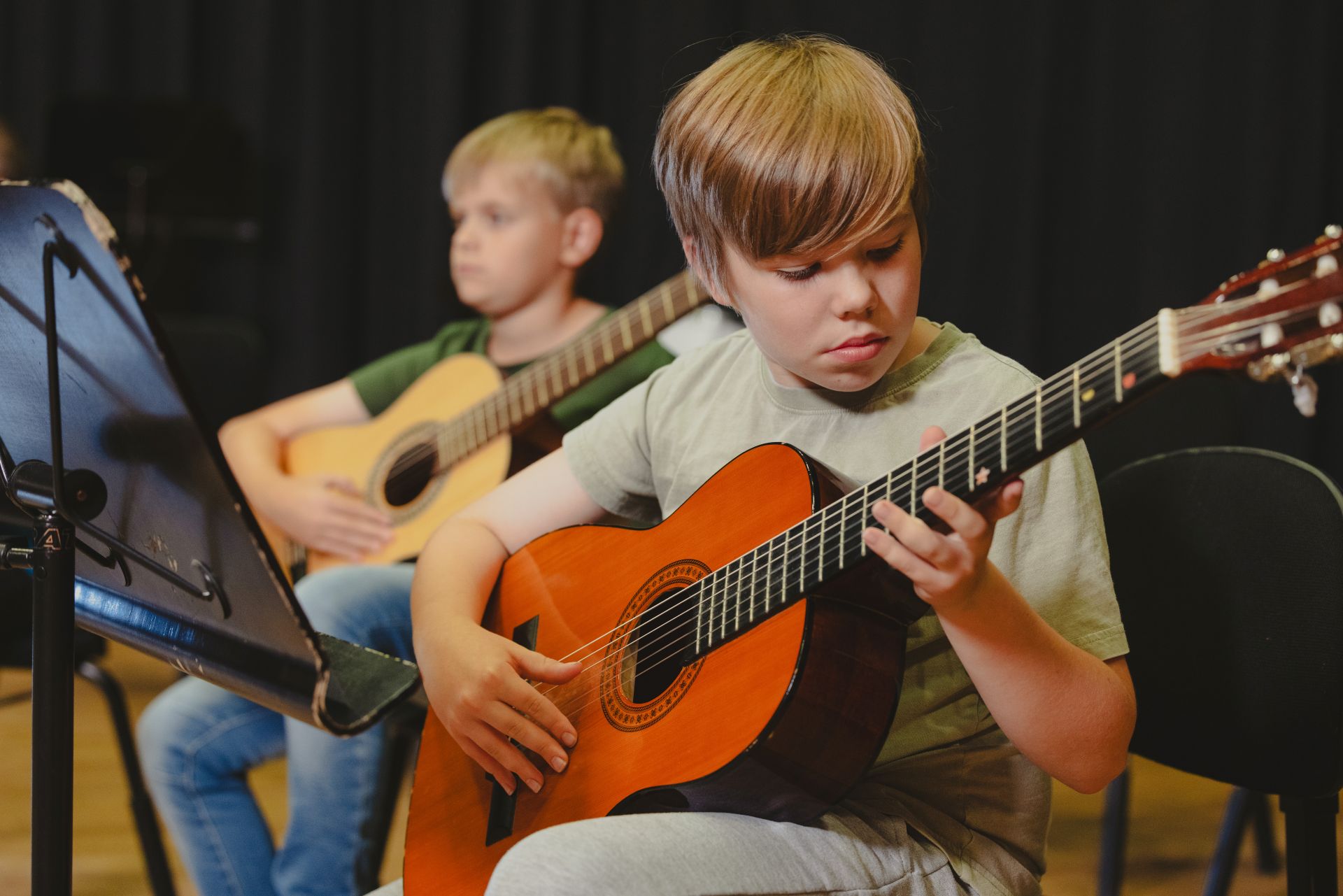
Guitar
The acoustic guitar is a versatile instrument capable of performing solo pieces in many styles. It is also suitable for ensemble playing with other guitarists or different instruments.
The repertoire includes pieces from classical music to rock and lighter popular music. The guitar is a popular instrument for both accompaniment and melodic playing.
Guitar studies can be started at about age 7.
Accordion
The accordion is a versatile and expressive instrument suitable for many musical genres. Its sound is rich and recognizable, and it can play both melodies and accompaniment.
The accordion works excellently as a solo instrument but also fits well into different groupings and ensemble playing.
Accordion studies can be started around age 7 or later.
Electric bass
The electric bass functions as the rhythmic and harmonic foundation of music, providing a supportive base for a piece. Its sound is exciting and essential especially in bands.
The electric bass is quick to get started with, and even beginners can experience success with simple pieces. The instrument is versatile and used in many different musical styles.
Electric bass studies can be started at around age 9 or later.
Electric guitar
The electric guitar is a popular instrument used in many ensembles and musical styles. Its sound is versatile and modifiable, offering wide possibilities for different playing techniques and tones.
The electric guitar can be used for both accompaniment and solos and is well suited to ensemble playing in bands. The instrument plays a central role in many contemporary music genres.
Electric guitar studies can be started at around age 9 or later.
Rhythm piano
With rhythm piano you can play both solo pieces and make music together with others, for example in a band. It is also excellent for accompanying other instruments and singing.
Rhythm piano is used in light popular music and offers versatile possibilities for accompaniment and improvisation.
Rhythm piano studies can be started at around age 9 or later.
Drums and percussion
Drums are a central part of most bands; their role is to accompany the music, maintain tempo and create a strong rhythmic foundation. A drum kit is a versatile instrument with countless rhythms and styles to play.
Drums suit both ensemble playing and solo performance, and playing offers many opportunities for expression and creativity.
At Kuula-opisto it is also possible to study classical percussion instruments such as marimba, xylophone and timpani.
Drum and percussion studies can be started around age 9 or later.
Contact us
-

Mikkola-Blomberg Sanna
Teacher at the Kuula Institute, Vaasa City Institutes
Violin Teacher and Teacher of Musicianship in Vaasa. Chair of the Strings Department.
-

Flute Teacher in Vaasa, Isokyrö and Laihia. Chair of the Wind Faculty and Conductor of the Start Wind Orchestra.
-

Piano Teacher and Chair of the Piano Faculty.
-

Guitar Teacher in Vaasa and Isokyrö, Chair of the Guitar Faculty, and Teacher in Digilo.
-

Areas of responsibility: string instruments, voice, guitar, percussion, and rhythm music
-

Areas of responsibility: piano, wind instruments, accordion, musicianship skills, early childhood music education, study guidance, and activities in Isokyrö and Laihia.
-
Kuula Institute

Phone
Customer service mon-thu 10-14: 040 0430 131

Address
Visiting address: Laivakatu 16, Vaasa

Opening hours
Office hours: Mon-Fri 9 -15.45
